
Getting Clay County Court Records
Begin with the court, not just a name. The Clay County District Clerk holds the files of the 97th District Court. That court covers felony cases plus district-level civil and family matters. The Clay County Clerk keeps the constitutional County Court's criminal, civil, probate, and guardianship files. Traffic tickets, Class C cases, small claims, debt claims, evictions, and repair-and-remedy suits all live with the Clay County Justice Court.
You can reach Clay County court records through iDocket or re:SearchTX when coverage allows. The right counter, mail, or an office-approved phone, email, or fax inquiry also works. The county does not promise a public self-service terminal. Ask before you count on one. Follow this request path:
- Identify the court and obtain the cause number if possible.
- Name the exact docket, order, judgment, pleading, or other document sought.
- Choose online access, counter service, mail, or an office-approved electronic channel.
- Ask whether the item is public and available as a plain or certified copy.
- Confirm the fee, payment method, delivery method, and estimated completion time.
Clay County’s Split Clerk Map
No single courthouse search reaches every Clay County court record. The 97th District Court serves Archer, Clay, and Montague Counties. Its Clay filings still sit with the Clay County District Clerk. County Court files go to the County Clerk. Lower-court files stay with the Justice Court or the municipal court named on a citation. That split has a cost. A valid case can seem missing from the first database you check.
| Custodian | Clay County records | Primary access |
|---|---|---|
| District Clerk | District felony, civil, and family cases | Counter, mail, phone, email, re:SearchTX |
| County Clerk | County criminal, civil, probate, guardianship | iDocket, counter, mail, phone, email |
| Justice or municipal court | Traffic, Class C, and lower civil matters | Court counter, phone, records request |
Read the case caption and the court name together. A County Court misdemeanor is not a 97th District Court felony record, even when both are Clay County cases.
Court Record Types
A docket is a chronological index of events. It is not the whole file. Behind those entries, a Clay County court record may hold a petition, indictment, answer, motion, return, exhibit, signed order, judgment, or bill of costs. A certified copy is different again: a clerk-authenticated reproduction, usually marked with a certificate or seal. Each piece serves its own purpose.
- Docket sheets and case-event registers
- Pleadings, motions, returns, and filed notices
- Orders, judgments, sentences, and dispositions
- Probate, guardianship, and public family-case materials
- Financial records, including assessed costs and balances
Transcripts take a separate route. The 97th District Court directory names the court reporter as the source for transcript requests. So do not assume a clerk record request will include spoken testimony from the paper case file.
iDocket Index Versus Record Images
The County Clerk points to iDocket as its case-management route. An index hit proves a case exists and shows basic case data. It does not make every document image free or public. Similarly, re:SearchTX offers statewide views of cases, filings, text, and hearings, but registration rules, participating-court coverage, and document purchase limits shape what you can actually pull.
Write down the cause number, court, filing date, and document title from the index. Then ask the custodian for the specific image if it is unavailable. The official re:SearchTX screen shows the statewide search layer. View the official re:SearchTX source used for this Clay County court record search.
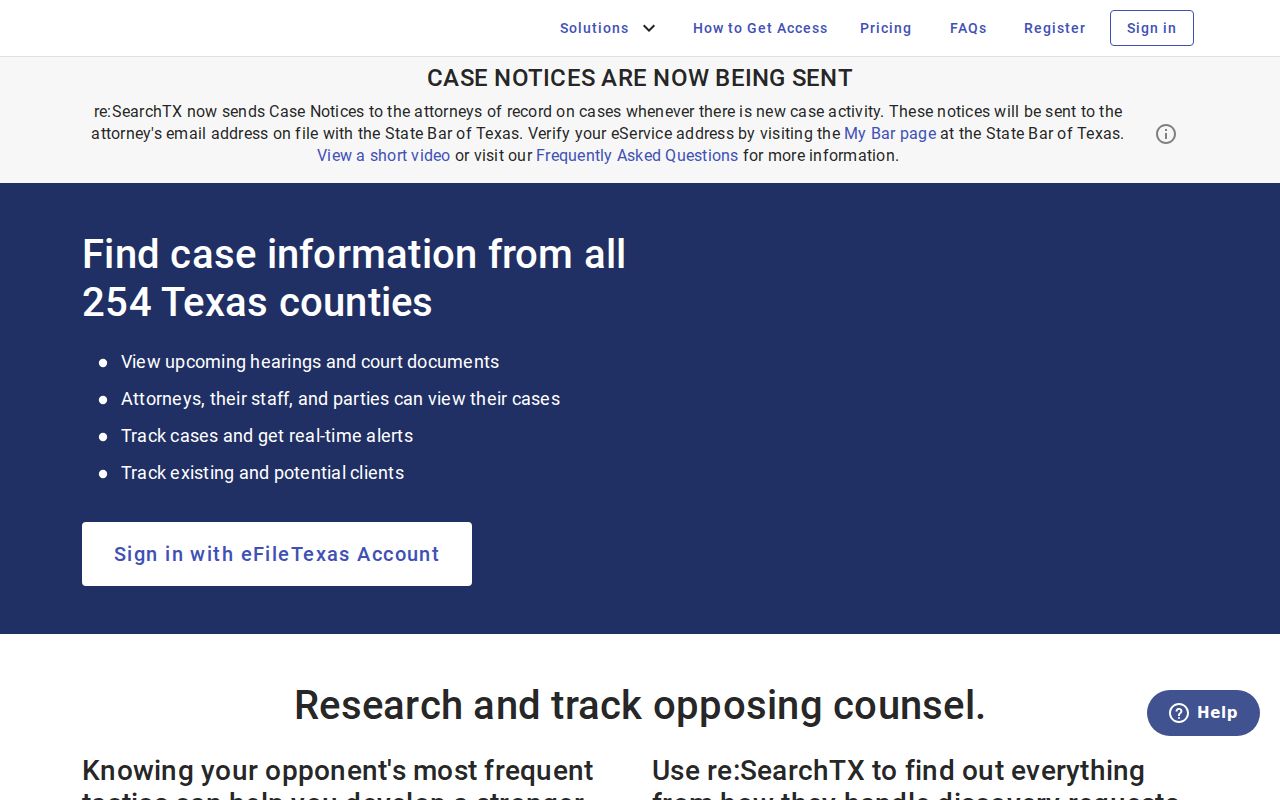
That interface helps you locate statewide metadata. For an official copy, the responsible Clay clerk remains the authority.
Inside a Clay County Court Record
Clay County records differ by case type, but some fields show up again and again. Local examples include cause numbers like 2024-0000123. A caption, a court label, the filing history, hearing entries, and a disposition appear too. A redacted Clay bill-of-costs sample makes the same point from another angle. A public record may center on financial and certification fields. It may not include the full set of pleadings.
| Cause number | The clerk’s unique identifier used to retrieve the file. |
|---|---|
| Caption and court | Parties or case style plus the court that holds the action. |
| Docket entries | Dated filings, service events, settings, orders, and disposition events. |
| Filed documents | Available petitions, motions, notices, orders, judgments, and returns. |
| Financial fields | Costs assessed, payment entries, balances, funds, and certification lines where applicable. |
A missing image does not prove a filing never happened. Check whether it is paper-only, archived, restricted, sealed, or just outside the portal's coverage.
Older Clay County Record Requests
Clay County's record systems grew over decades. Older files may be bound, filmed, partly scanned, stored off site, or indexed under an earlier numbering practice. The county's public pages post no universal retention schedule or archive retrieval fee. Give the clerk a date range, court, case style, and likely record type. Skip the broad name-only request.
When an old case is absent online, ask whether the office can run its internal index. Ask also whether retrieval adds time. History plays a part too: the Clay County Courthouse was built in 1884 and entered in the National Register in 1978. That is why old court books and modern electronic records coexist in one county system.
Note: Online absence is a search clue. It is not proof that a Clay County court record was sealed or destroyed.
Fees and Certified Copies
A plain copy just reproduces the page. A certified copy carries the clerk's stamp of authentication. That stamp is what most courts and agencies require. The Clay County Clerk's fee schedule sets $1 per paper page, and $1 for an electronic-to-paper copy. An electronic-to-electronic copy of one through ten pages runs $1, with $0.10 for each added page after that. Certification adds $5 per document. Justice Court keeps its own schedule. It charges $1 for the first page and $0.25 for each added page.
| Clay County record service | Published amount |
|---|---|
| County Clerk paper copy | $1 per page |
| County Clerk electronic copy, 1–10 pages | $1 |
| Each added electronic page | $0.10 |
| County Clerk certification | $5 per document |
| Justice Court copy | $1 first page; $0.25 each added page |
| District Clerk copy or transcript | Confirm current quote with the custodian |
Clay County District Clerk
100 North Bridge Street, first floor east
Henrietta, TX 76365
940-538-4561
Clay County Transcript Route
Want the words spoken at a hearing in Clay County? That request goes to the court reporter, not the District Clerk. The 97th District Court directory lists Mary A. Cantrell as its reporter. The contact is courtreporter@97thdistrictcourt.com. She handles transcript work. The Clerk keeps the filed papers, and the two jobs never overlap.
A transcript captures the spoken record. It is not a docket sheet and not a pleading. Before ordering, gather the hearing date, the court, the cause number, and which proceeding you need. Then ask about the estimate, deposit, format, and delivery time. No universal Clay County rate or turnaround is published. One more thing: if you need an order or judgment signed after the hearing, that copy comes from the District Clerk. Knowing the difference saves days of routing.
Sealed Records and Public Access
Texas law leans toward openness. Still, not every Clay County court record is fully public. Juvenile files, adoptions, protective orders, mental-health cases, confidential identifiers, and court-sealed material can all be restricted. A public index may show only a slim entry. It can list the case while holding back a party detail or an image. The flip side matters too. A blank portal result can simply mean the wrong clerk or thin coverage, not a sealed case.
Key access rules:
Texas Rule of Judicial Administration 12 governs covered judicial-record requests and provides a denial review path.
Texas Rule of Civil Procedure 76a states the civil-record presumption and sealing procedure.
Texas Government Code Chapter 552 supplies the Public Information Act framework, though court case records follow judicial rules and clerk procedures.
Redactions shield Social Security numbers, full financial account numbers, confidential addresses, and other protected identifiers from public view. Whether a specific filing gets released is a call only the court or an authorized custodian can make.
Clay County Case-File Fallback
Try a normal case-file request first. Rule 12 is no shortcut. It does not replace asking the right clerk for an order, judgment, or docket. Be precise: name Clay County, the court, the cause number, the case style, the document, the date range, the copy type, and how you want it delivered. If the clerk calls the record restricted, ask which rule or order controls and whether an authorized-person procedure exists.
For an ordinary non-adjudicative judicial record that Rule 12 covers, send the written request to the records custodian. The Texas Office of Court Administration does not hold individual Clay County case records. It cannot fetch a local case file. After a covered denial, a Rule 12 appeal may apply. It still will not open a sealed file.